How We Build Free 3D Websites for Local Businesses
We've built nine free websites for local cafés so far, and no two look alike. A rooftop venue got a film that flies you into a glass dome. A patisserie got its signature cake pouring on scroll. A book café got a book whose pages turn.
People ask how that's possible without charging for it, and whether it's just a template with the colours changed. It isn't. Here is the process we follow for every site, step by step, with what we learned along the way.
The seven steps: read the business → find its signature → choose the scene → build and render it in 3D → write the site from real reviews → make contacting the business effortless → make it fast on phones. Then the owner sees a private preview.
Every site starts from the business's public Google listing: name, category, address, opening hours, photos, rating and reviews. Owners don't fill in a questionnaire. Everything we need to begin is already there, written by the people who know the place best: its customers.
We read the reviews looking for the thing people keep coming back to. At Amintiri, it's the Biscoff pull-up cake. At The Dome Cafe, it's booking a private glass dome for a celebration. At Katha Kavana, it's reading a book over coffee. At L81, it's the quiet garden. That moment becomes the centre of the site.
Next we decide how a visitor should experience that moment, and what the rest of the site should feel like. Amintiri became a light, pastel, editorial patisserie site. Marseli became minimalist and luxurious. Casa Fresco, a Goa-style beach-shack café, became one continuous sunset over the sea.
We also check that everything fits the business. The Amrith Cafe is pure vegetarian, so every image on its site is too, down to the smallest decoration.
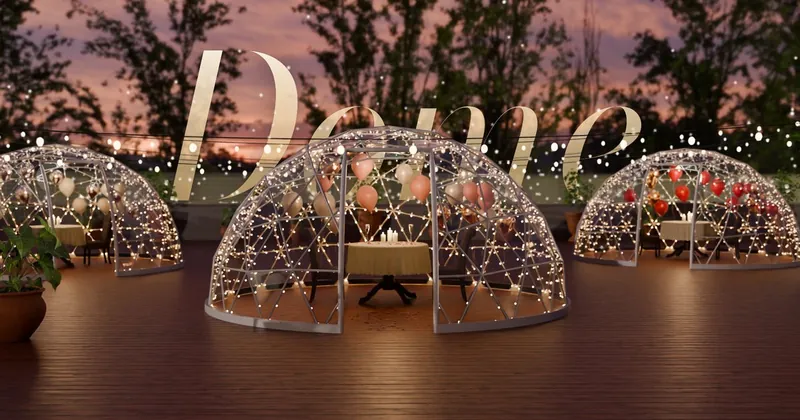
The Dome Cafe: geodesic glass domes, a cloth-simulated tablecloth and dusk light, path-traced in Blender.
Most scenes are built in Blender and rendered with path tracing, which simulates how light really bounces, so glass, sauce, steam and sunlight look real. We use free, photo-scanned models and lighting from Poly Haven, and real physics simulations where it matters: a cloth simulation for the Dome's tablecloths, and a viscous-fluid simulation for the Biscoff sauce on Amintiri's cake.
The render becomes a scroll film: dozens of frames that play forward and backward as you scroll. We render separate versions for wide desktop screens and tall phone screens, so neither gets a cropped picture.
Some scenes need to be live instead. Casa Fresco's sea and sky are drawn in real time in the browser with three.js, so the time of day can follow your scroll and you can tap to release a lantern over the water.
The words come from the business and its customers, not from a template. Menu highlights are the dishes reviewers mention most. Reviews are shown with each reviewer's name. "Good to know" sections answer the questions people ask in reviews, such as parking, seating and when it's quiet.
Every site has one-tap call, WhatsApp and directions. Where the business takes bookings, we build a booking card that sends a ready-written WhatsApp message. The Dome's planner asks the occasion (birthday, anniversary, proposal, date night or friends' night) and redecorates the dome to match before sending. Katha Kavana's and L81's reservation cards use custom date and time pickers that are easy to use on a phone.
3D is only worth it if the site still works on an ordinary phone. Each site checks what the device can handle. Visitors using data saver, and people who've asked their phone for reduced motion, get beautiful still images instead of the film. Phones with less memory get a lighter version that holds fewer frames at once. We go into detail in do 3D websites slow down phones?
We also test the awkward cases. One early film crashed Chrome when visitors scrolled back up after reaching the end, so we rebuilt how frames are held in memory. On phones with large text settings, the Dome's planner grew wider than its panel, so we fixed that too. These are the details that separate a demo from a website a business can rely on.
Then: a private preview, and a live address
Each site lives at its own address, such as katha.grabnear.com. Before anything is public, the owner gets a private preview link and can send corrections, newer photos or an updated menu. After that, the link goes on their Google listing, Instagram bio and WhatsApp profile.
✅ Want to see the results? All nine sites are live on the website showcase. Open them on your phone and scroll slowly.
Why we do it for free
GrabNear works with local businesses every day, and many of them have no website, or one that does them no justice. We're starting with free websites so owners can see what a great one does for them. There's no obligation.
Want us to build yours?
Send your business name and Google Maps link. We'll do steps 1 to 7 and send you the preview.
Request a free website →Frequently Asked Questions
Related: 3D websites for small businesses · Café website design ideas · Get a free website